Loading...
Searching...
No Matches
Vector< T, InlineCapacity >
#include <Ultralight/Vector.h>
Overview
template<typename T, size_t InlineCapacity = 4>
class ultralight::Vector< T, InlineCapacity >
class ultralight::Vector< T, InlineCapacity >
A std::vector-like container with small buffer optimization and ABI-safe allocation.
This container can be used safely in public API boundaries where std::vector cannot, because STL types are not guaranteed to be ABI-compatible across different compilers, standard library implementations, or even different build configurations.
All heap allocation is routed through UltralightCore's exported allocator functions (ul_malloc / ul_free), ensuring that memory allocated by the library is always freed by the library – regardless of which runtime the caller was built with.
Small Buffer Optimization (SBO)
When InlineCapacity > 0 (the default), the first N elements are stored inline within the Vector object itself, avoiding heap allocation for common small lists. Once the size exceeds InlineCapacity, the Vector transparently switches to heap storage.
Type support
Works with both trivially-copyable types (uses memcpy/realloc fast paths) and non-trivial types like RefPtr<T> (proper construction, destruction, and move semantics).
Example
Vector<int> v = {1, 2, 3}; // stored inline (default InlineCapacity = 4)
v.push_back(4); // still inline
v.push_back(5); // transitions to heap
Vector<int, 0> heap_only; // pure heap, no inline storage
Vector<int, 16> large_inline; // 16 elements inline before heap
A std::vector-like container with small buffer optimization and ABI-safe allocation.
Definition Vector.h:88
- Template Parameters
-
T Element type. InlineCapacity Number of elements stored inline before heap allocation (default 4). Use 0 for pure heap storage with no inline overhead.
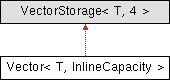
Inheritance diagram for Vector< T, InlineCapacity >:
Public Types | |
| using | value_type = T |
| using | size_type = size_t |
| using | difference_type = ptrdiff_t |
| using | reference = T& |
| using | const_reference = const T& |
| using | pointer = T* |
| using | const_pointer = const T* |
| using | iterator = T* |
| using | const_iterator = const T* |
Public Member Functions | |
| Vector ()=default | |
| Construct an empty vector. | |
| Vector (size_t count) | |
Construct a vector with count value-initialized elements. | |
| Vector (size_t count, const T &value) | |
Construct a vector with count copies of value. | |
| Vector (std::initializer_list< T > init) | |
| template<typename InputIt, typename = typename std::enable_if<!std::is_integral<InputIt>::value>::type> | |
| Vector (InputIt first, InputIt last) | |
| Vector (const Vector &other) | |
| template<size_t OtherInline> | |
| Vector (const Vector< T, OtherInline > &other) | |
| Vector (Vector &&other) noexcept(InlineCapacity==0||std::is_nothrow_move_constructible< T >::value) | |
| template<size_t OtherInline> | |
| Vector (Vector< T, OtherInline > &&other) noexcept(std::is_nothrow_move_constructible< T >::value) | |
| ~Vector () | |
| Vector & | operator= (const Vector &other) |
| template<size_t OtherInline> | |
| Vector & | operator= (const Vector< T, OtherInline > &other) |
| Vector & | operator= (Vector &&other) noexcept(InlineCapacity==0||std::is_nothrow_move_constructible< T >::value) |
| template<size_t OtherInline> | |
| Vector & | operator= (Vector< T, OtherInline > &&other) noexcept(std::is_nothrow_move_constructible< T >::value) |
| Vector & | operator= (std::initializer_list< T > init) |
| void | assign (size_t count, const T &value) |
| template<typename InputIt, typename = typename std::enable_if<!std::is_integral<InputIt>::value>::type> | |
| void | assign (InputIt first, InputIt last) |
| void | assign (std::initializer_list< T > init) |
| T & | operator[] (size_t index) |
| Access element by index. | |
| const T & | operator[] (size_t index) const |
| T & | at (size_t index) |
| Access element by index with bounds checking (asserts in debug builds). | |
| const T & | at (size_t index) const |
| T & | front () |
| const T & | front () const |
| T & | back () |
| const T & | back () const |
| T * | data () |
| const T * | data () const |
| iterator | begin () |
| const_iterator | begin () const |
| const_iterator | cbegin () const |
| iterator | end () |
| const_iterator | end () const |
| const_iterator | cend () const |
| bool | empty () const |
| size_t | size () const |
| size_t | capacity () const |
| Returns the number of elements that can be held without allocating. | |
| void | reserve (size_t min_capacity) |
Ensure capacity for at least min_capacity elements, allocating if necessary. | |
| void | shrink_to_fit () |
| Reduce capacity to fit the current size. | |
| void | clear () |
| void | push_back (const T &value) |
| void | push_back (T &&value) |
| template<typename... Args> | |
| T & | emplace_back (Args &&... args) |
| Construct an element in-place at the end of the vector. | |
| void | unchecked_append (const T &value) |
| Append an element without checking capacity. | |
| template<typename... Args> | |
| T & | unchecked_emplace_back (Args &&... args) |
| Construct an element in-place at the end without checking capacity. | |
| void | pop_back () |
| T | take_last () |
| Remove the last element and return it by move. | |
| iterator | insert (const_iterator pos, const T &value) |
| iterator | insert (const_iterator pos, T &&value) |
| template<typename... Args> | |
| iterator | emplace (const_iterator pos, Args &&... args) |
| iterator | erase (const_iterator pos) |
| iterator | erase (const_iterator first, const_iterator last) |
| void | resize (size_t count) |
| void | resize (size_t count, const T &value) |
| void | swap (Vector &other) |
| template<size_t OtherInline> | |
| void | append_vector (const Vector< T, OtherInline > &other) |
| Append all elements from another vector. | |
| template<size_t OtherInline> | |
| void | append_vector (Vector< T, OtherInline > &&other) |
| Move-append all elements from another vector, leaving it empty. | |
Friends | |
| template<typename U, size_t M> | |
| class | Vector |
| bool | operator== (const Vector &a, const Vector &b) |
| bool | operator!= (const Vector &a, const Vector &b) |
Member Typedef Documentation
◆ const_iterator
template<typename T, size_t InlineCapacity = 4>
| using const_iterator = const T* |
◆ const_pointer
template<typename T, size_t InlineCapacity = 4>
| using const_pointer = const T* |
◆ const_reference
template<typename T, size_t InlineCapacity = 4>
| using const_reference = const T& |
◆ difference_type
template<typename T, size_t InlineCapacity = 4>
| using difference_type = ptrdiff_t |
◆ iterator
template<typename T, size_t InlineCapacity = 4>
| using iterator = T* |
◆ pointer
template<typename T, size_t InlineCapacity = 4>
| using pointer = T* |
◆ reference
template<typename T, size_t InlineCapacity = 4>
| using reference = T& |
◆ size_type
template<typename T, size_t InlineCapacity = 4>
| using size_type = size_t |
◆ value_type
template<typename T, size_t InlineCapacity = 4>
| using value_type = T |
Constructor & Destructor Documentation
◆ Vector() [1/9]
template<typename T, size_t InlineCapacity = 4>
|
default |
Construct an empty vector.
No heap allocation is performed.
◆ Vector() [2/9]
template<typename T, size_t InlineCapacity = 4>
|
inlineexplicit |
Construct a vector with count value-initialized elements.
◆ Vector() [3/9]
template<typename T, size_t InlineCapacity = 4>
|
inline |
Construct a vector with count copies of value.
◆ Vector() [4/9]
template<typename T, size_t InlineCapacity = 4>
|
inline |
◆ Vector() [5/9]
template<typename T, size_t InlineCapacity = 4>
template<typename InputIt, typename = typename std::enable_if<!std::is_integral<InputIt>::value>::type>
|
inline |
◆ Vector() [6/9]
template<typename T, size_t InlineCapacity = 4>
|
inline |
◆ Vector() [7/9]
template<typename T, size_t InlineCapacity = 4>
template<size_t OtherInline>
|
inline |
◆ Vector() [8/9]
template<typename T, size_t InlineCapacity = 4>
|
inlinenoexcept |
◆ Vector() [9/9]
template<typename T, size_t InlineCapacity = 4>
template<size_t OtherInline>
|
inlinenoexcept |
◆ ~Vector()
template<typename T, size_t InlineCapacity = 4>
|
inline |
Member Function Documentation
◆ append_vector() [1/2]
template<typename T, size_t InlineCapacity = 4>
template<size_t OtherInline>
|
inline |
Append all elements from another vector.
Works across different InlineCapacity values.
◆ append_vector() [2/2]
template<typename T, size_t InlineCapacity = 4>
template<size_t OtherInline>
|
inline |
Move-append all elements from another vector, leaving it empty.
◆ assign() [1/3]
template<typename T, size_t InlineCapacity = 4>
template<typename InputIt, typename = typename std::enable_if<!std::is_integral<InputIt>::value>::type>
|
inline |
◆ assign() [2/3]
template<typename T, size_t InlineCapacity = 4>
|
inline |
◆ assign() [3/3]
template<typename T, size_t InlineCapacity = 4>
|
inline |
◆ at() [1/2]
template<typename T, size_t InlineCapacity = 4>
|
inline |
Access element by index with bounds checking (asserts in debug builds).
◆ at() [2/2]
template<typename T, size_t InlineCapacity = 4>
|
inline |
◆ back() [1/2]
template<typename T, size_t InlineCapacity = 4>
|
inline |
◆ back() [2/2]
template<typename T, size_t InlineCapacity = 4>
|
inline |
◆ begin() [1/2]
template<typename T, size_t InlineCapacity = 4>
|
inline |
◆ begin() [2/2]
template<typename T, size_t InlineCapacity = 4>
|
inline |
◆ capacity()
template<typename T, size_t InlineCapacity = 4>
|
inline |
Returns the number of elements that can be held without allocating.
For a default-constructed vector with InlineCapacity > 0, this equals InlineCapacity (inline storage is always available without heap allocation).
◆ cbegin()
template<typename T, size_t InlineCapacity = 4>
|
inline |
◆ cend()
template<typename T, size_t InlineCapacity = 4>
|
inline |
◆ clear()
template<typename T, size_t InlineCapacity = 4>
|
inline |
◆ data() [1/2]
template<typename T, size_t InlineCapacity = 4>
|
inline |
◆ data() [2/2]
template<typename T, size_t InlineCapacity = 4>
|
inline |
◆ emplace()
template<typename T, size_t InlineCapacity = 4>
template<typename... Args>
|
inline |
◆ emplace_back()
template<typename T, size_t InlineCapacity = 4>
template<typename... Args>
|
inline |
Construct an element in-place at the end of the vector.
◆ empty()
template<typename T, size_t InlineCapacity = 4>
|
inline |
◆ end() [1/2]
template<typename T, size_t InlineCapacity = 4>
|
inline |
◆ end() [2/2]
template<typename T, size_t InlineCapacity = 4>
|
inline |
◆ erase() [1/2]
template<typename T, size_t InlineCapacity = 4>
|
inline |
◆ erase() [2/2]
template<typename T, size_t InlineCapacity = 4>
|
inline |
◆ front() [1/2]
template<typename T, size_t InlineCapacity = 4>
|
inline |
◆ front() [2/2]
template<typename T, size_t InlineCapacity = 4>
|
inline |
◆ insert() [1/2]
template<typename T, size_t InlineCapacity = 4>
|
inline |
◆ insert() [2/2]
template<typename T, size_t InlineCapacity = 4>
|
inline |
◆ operator=() [1/5]
template<typename T, size_t InlineCapacity = 4>
|
inline |
◆ operator=() [2/5]
template<typename T, size_t InlineCapacity = 4>
template<size_t OtherInline>
|
inline |
◆ operator=() [3/5]
template<typename T, size_t InlineCapacity = 4>
|
inline |
◆ operator=() [4/5]
template<typename T, size_t InlineCapacity = 4>
|
inlinenoexcept |
◆ operator=() [5/5]
template<typename T, size_t InlineCapacity = 4>
template<size_t OtherInline>
|
inlinenoexcept |
◆ operator[]() [1/2]
template<typename T, size_t InlineCapacity = 4>
|
inline |
Access element by index.
No bounds checking.
◆ operator[]() [2/2]
template<typename T, size_t InlineCapacity = 4>
|
inline |
◆ pop_back()
template<typename T, size_t InlineCapacity = 4>
|
inline |
◆ push_back() [1/2]
template<typename T, size_t InlineCapacity = 4>
|
inline |
◆ push_back() [2/2]
template<typename T, size_t InlineCapacity = 4>
|
inline |
◆ reserve()
template<typename T, size_t InlineCapacity = 4>
|
inline |
Ensure capacity for at least min_capacity elements, allocating if necessary.
◆ resize() [1/2]
template<typename T, size_t InlineCapacity = 4>
|
inline |
◆ resize() [2/2]
template<typename T, size_t InlineCapacity = 4>
|
inline |
◆ shrink_to_fit()
template<typename T, size_t InlineCapacity = 4>
|
inline |
Reduce capacity to fit the current size.
If InlineCapacity > 0 and the current size fits within the inline buffer, storage is moved back to inline (freeing the heap allocation).
◆ size()
template<typename T, size_t InlineCapacity = 4>
|
inline |
◆ swap()
template<typename T, size_t InlineCapacity = 4>
|
inline |
◆ take_last()
template<typename T, size_t InlineCapacity = 4>
|
inline |
Remove the last element and return it by move.
◆ unchecked_append()
template<typename T, size_t InlineCapacity = 4>
|
inline |
Append an element without checking capacity.
Caller must ensure size() < capacity().
◆ unchecked_emplace_back()
template<typename T, size_t InlineCapacity = 4>
template<typename... Args>
|
inline |
Construct an element in-place at the end without checking capacity.
Caller must ensure size() < capacity().
Friends And Related Symbol Documentation
◆ operator!=
template<typename T, size_t InlineCapacity = 4>
|
friend |
◆ operator==
template<typename T, size_t InlineCapacity = 4>
|
friend |
◆ Vector
template<typename T, size_t InlineCapacity = 4>
template<typename U, size_t M>
|
friend |
The documentation for this class was generated from the following file:
- Ultralight/Vector.h