Loading...
Searching...
No Matches
Node
#include <Ultralight/dom/Node.h>
Overview
A reference to an item in the DOM tree.
While query methods like Document::querySelector() find only elements, Node represents any item in the document hierarchy.
Use Node to walk tree relationships when your application needs to reach content that element queries skip.
Consider an element containing both text and markup:
<p id="greeting">Howdy <b>world</b>!</p>
You can step from the element to its first child and narrow the next sibling to an element:
dom::Element greeting = document.getElementById("greeting");
dom::Node first = greeting.firstChild();
Log(first.nodeName()); // "#text" (the "Howdy " text)
Log(bold.tagName()); // "B"
std::string tagName() const
Get the element's tag name (tagName).
Definition Element.h:1222
Node nextSibling() const
Get the node's next sibling of any kind (nextSibling).
Definition Node.h:303
Node firstChild() const
Get the node's first child of any kind (firstChild).
Definition Node.h:280
Element AsElement() const
Get this node as an Element.
Definition Element.h:3452
std::string nodeName() const
Get the node's name (nodeName).
Definition Node.h:254
Kinds of Nodes
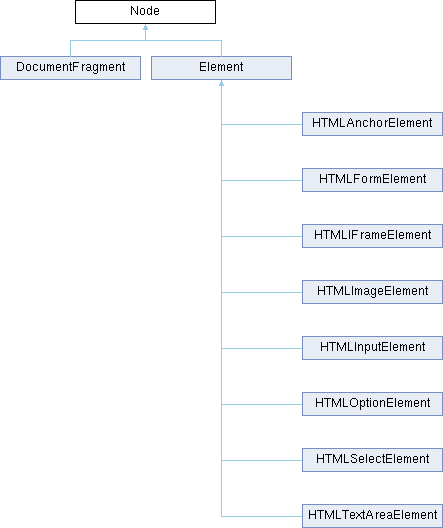
Both dom::Element and dom::DocumentFragment are Nodes. Unlike on the web, dom::Document is a separate type and doesn't inherit from Node (call ownerDocument() on any node to reach its document).
nodeType() returns the kind of node, and nodeName() returns its name. Call AsElement() to narrow a node to a dom::Element (it returns an empty handle for text and comments).
Traversal methods differ in which node kinds they visit:
- Node methods visit every child. Calls like firstChild() and nextSibling() return text and comments alongside elements.
- Element methods visit elements only. Calls on dom::Element like Element::firstElementChild() and Element::nextElementSibling() skip text and comments.
Like other DOM handles, a Node is always Valid, Empty, or Gone (see dom::Element).
Text and Comment Nodes
You can create standalone text and comment nodes on the document using Document::createTextNode() and Document::createComment(). Passing strings to insertion methods like Element::append(), Element::prepend(), or before() creates text nodes automatically (strings are never parsed as markup).
Assigning to nodeValue updates a text node in place, leaving sibling nodes untouched (unlike assigning to textContent on the parent):
dom::Element scoreboard = document.getElementById("score");
dom::Node points = document.createTextNode("0");
void append(T &&... nodes) const
Add nodes and strings to the end of this element, after its last child (append).
Definition Element.h:768
detail::NodeStringProp< detail::NodeValueTag > nodeValue
The text of a text or comment node (nodeValue).
Definition Node.h:154
- Note
- Whitespace between HTML tags becomes a text node (firstElementChild() skips it).
Inheritance diagram for Node:
Static Public Member Functions | |
| static Node | Adopt (ULDOMNode handle) |
| Wrap a C handle you own, taking ownership of it. | |
| static Node | FromBorrowed (ULDOMNode handle) |
| Wrap a C handle the library owns (eg, a callback argument), adding a reference. | |
Public Member Functions | |
| Node () | |
| Create an empty Node. | |
| Node (const Node &other) | |
| Copy constructor (both handles refer to the same node). | |
| Node (Node &&other) noexcept | |
| Move constructor (other becomes empty). | |
| Node & | operator= (Node other) noexcept |
| Assignment (copies or moves). | |
| ~Node () | |
| Destroy this handle (the node itself isn't affected). | |
| operator bool () const | |
| Whether or not this Node is valid (see IsAlive()). | |
| bool | IsEmpty () const |
| Whether or not this Node is empty (it holds no handle). | |
| bool | IsAlive () const |
| Whether or not this Node is valid (it isn't empty and its page is still alive). | |
| bool | IsSame (const Node &other) const |
| Whether or not two handles refer to the same node (isSameNode). | |
| NodeType | nodeType () const |
| Get the kind of node (nodeType). | |
| std::string | nodeName () const |
| Get the node's name (nodeName). | |
| Node | parentNode () const |
| Get the node's parent (parentNode). | |
| Element | parentElement () const |
| Get the node's parent element (parentElement). | |
| Node | firstChild () const |
| Get the node's first child of any kind (firstChild). | |
| Node | lastChild () const |
| Get the node's last child of any kind (lastChild). | |
| Node | previousSibling () const |
| Get the node's previous sibling of any kind (previousSibling). | |
| Node | nextSibling () const |
| Get the node's next sibling of any kind (nextSibling). | |
| NodeList | childNodes () const |
| Get the node's children of every kind in order (childNodes). | |
| bool | hasChildNodes () const |
| Whether or not the node has any children (hasChildNodes). | |
| bool | isConnected () const |
| Whether or not the node is in its document (isConnected). | |
| Document | ownerDocument () const |
| Get the document this node belongs to (ownerDocument). | |
| Element | AsElement () const |
| Get this node as an Element. | |
| DocumentFragment | AsFragment () const |
| Get this node as a DocumentFragment. | |
| template<typename... T> requires ((detail::NodeOrString<T> && ...)) | |
| void | before (T &&... nodes) const |
| Insert nodes and strings just before this node, in its parent (before). | |
| template<typename... T> requires ((detail::NodeOrString<T> && ...)) | |
| Result< void > | before (Checked_t, T &&... nodes) const |
| Same as before(), but returns a Result with the reason for a failure (eg, a HierarchyRequestError for a cycle). | |
| template<typename... T> requires ((detail::NodeOrString<T> && ...)) | |
| void | after (T &&... nodes) const |
| Insert nodes and strings just after this node, in its parent (after). | |
| template<typename... T> requires ((detail::NodeOrString<T> && ...)) | |
| Result< void > | after (Checked_t, T &&... nodes) const |
| Same as after(), but returns a Result with the reason for a failure (eg, a HierarchyRequestError for a cycle). | |
| template<typename... T> requires ((detail::NodeOrString<T> && ...)) | |
| void | replaceWith (T &&... nodes) const |
| Replace this node with nodes and strings, in its parent (replaceWith). | |
| template<typename... T> requires ((detail::NodeOrString<T> && ...)) | |
| Result< void > | replaceWith (Checked_t, T &&... nodes) const |
| Same as replaceWith(), but returns a Result with the reason for a failure (eg, a HierarchyRequestError for a cycle). | |
| void | remove () const |
| Remove this node from its parent (remove). | |
| Result< void > | remove (Checked_t) const |
| Same as remove(), but returns a Result with the reason for a failure. | |
| ULDOMNode | raw () const |
| Get the C handle, for passing to the <Ultralight/CAPI/CAPI_DOMNode.h> functions. | |
| ULDOMNode | LeakRef () |
| Give up ownership of the C handle and return it. | |
Public Attributes | |
| detail::NodeStringProp< detail::NodeValueTag > | nodeValue |
| The text of a text or comment node (nodeValue). | |
| detail::NodeStringProp< detail::NodeTextContentTag > | textContent |
| The text of this node and all its descendants (textContent). | |
| detail::NodeStorage | detail_ |
| Internal storage (not part of the API). | |
Protected Member Functions | |
| Node (ULDOMNode handle) | |
Constructor & Destructor Documentation
◆ Node() [1/4]
|
inline |
Create an empty Node.
◆ Node() [2/4]
|
inline |
Copy constructor (both handles refer to the same node).
- Parameters
-
other The Node to copy.
◆ Node() [3/4]
|
inlinenoexcept |
Move constructor (other becomes empty).
- Parameters
-
other The Node to move from.
◆ ~Node()
|
inline |
Destroy this handle (the node itself isn't affected).
◆ Node() [4/4]
|
inlineexplicitprotected |
Member Function Documentation
◆ Adopt()
|
inlinestatic |
◆ after() [1/2]
template<typename... T>
requires ((detail::NodeOrString<T> && ...))
requires ((detail::NodeOrString<T> && ...))
|
inlinenodiscard |
Same as after(), but returns a Result with the reason for a failure (eg, a HierarchyRequestError for a cycle).
dom::Checked comes first here, before the nodes (node.after(dom::Checked, a, "b")).
- Returns
- Returns success (including when this node has no parent). Fails with a HierarchyRequestError if one of the nodes can't go there (eg, it's this node's parent or one of its ancestors).
◆ after() [2/2]
template<typename... T>
requires ((detail::NodeOrString<T> && ...))
requires ((detail::NodeOrString<T> && ...))
|
inline |
Insert nodes and strings just after this node, in its parent (after).
Each string is inserted as a new text node (it's never parsed as markup). This does nothing if the node has no parent.
- Parameters
-
nodes The nodes and strings to insert, in order. A node that's already in a document moves (even if it's one of this node's siblings).
- Note
- With more than one argument, the nodes leave their old positions before the insertion is checked (like the web), so a call that fails can leave them out of the page.
◆ AsElement()
|
inline |
◆ AsFragment()
|
inline |
Get this node as a DocumentFragment.
This is defined in <Ultralight/dom/DocumentFragment.h>. Include that header (or <Ultralight/DOM.h>) to call it.
- Returns
- Returns a DocumentFragment for the same node (empty if the node isn't a document fragment).
◆ before() [1/2]
template<typename... T>
requires ((detail::NodeOrString<T> && ...))
requires ((detail::NodeOrString<T> && ...))
|
inlinenodiscard |
Same as before(), but returns a Result with the reason for a failure (eg, a HierarchyRequestError for a cycle).
dom::Checked comes first here, before the nodes (node.before(dom::Checked, a, "b")).
- Returns
- Returns success (including when this node has no parent). Fails with a HierarchyRequestError if one of the nodes can't go there (eg, it's this node's parent or one of its ancestors).
◆ before() [2/2]
template<typename... T>
requires ((detail::NodeOrString<T> && ...))
requires ((detail::NodeOrString<T> && ...))
|
inline |
Insert nodes and strings just before this node, in its parent (before).
Each string is inserted as a new text node (it's never parsed as markup). This does nothing if the node has no parent.
- Parameters
-
nodes The nodes and strings to insert, in order. A node that's already in a document moves (even if it's one of this node's siblings).
- Note
- With more than one argument, the nodes leave their old positions before the insertion is checked (like the web), so a call that fails can leave them out of the page.
◆ childNodes()
|
inline |
Get the node's children of every kind in order (childNodes).
This is defined in <Ultralight/dom/NodeList.h>. Include that header (or <Ultralight/DOM.h>) to call it.
- Returns
- Returns the children, including text and comment nodes (an empty list if there are none).
- Note
- The list is a snapshot, where the web's childNodes is live. Call this again to see later changes.
◆ firstChild()
|
inline |
Get the node's first child of any kind (firstChild).
- Returns
- Returns the first child (empty if there's none).
◆ FromBorrowed()
|
inlinestatic |
◆ hasChildNodes()
|
inline |
Whether or not the node has any children (hasChildNodes).
- Returns
- Returns true if the node has at least one child of any kind.
◆ IsAlive()
|
inline |
Whether or not this Node is valid (it isn't empty and its page is still alive).
- Note
- Safe to call from any thread.
◆ isConnected()
|
inline |
Whether or not the node is in its document (isConnected).
A node you just created, or one you removed, isn't connected until you insert it into the page.
- Returns
- Returns true if the node is in the document (false for an empty Node or one whose page is gone).
◆ IsEmpty()
|
inline |
Whether or not this Node is empty (it holds no handle).
◆ IsSame()
|
inline |
Whether or not two handles refer to the same node (isSameNode).
- Parameters
-
other The handle to compare with.
- Returns
- Returns true if both handles are valid and refer to the same node.
◆ lastChild()
|
inline |
Get the node's last child of any kind (lastChild).
- Returns
- Returns the last child (empty if there's none).
◆ LeakRef()
|
inline |
Give up ownership of the C handle and return it.
This Node becomes empty.
- Returns
- Returns the handle. You must call ulDestroyDOMNode() when finished.
◆ nextSibling()
|
inline |
Get the node's next sibling of any kind (nextSibling).
- Returns
- Returns the next sibling (empty if there's none).
◆ nodeName()
|
inline |
Get the node's name (nodeName).
- Returns
- Returns the tag name for an element (uppercase for HTML, eg, DIV), #text for a text node, or #comment for a comment.
◆ nodeType()
|
inline |
Get the kind of node (nodeType).
- Returns
- Returns the kind of node (NodeType::None for an empty Node or one whose page is gone).
◆ operator bool()
◆ operator=()
◆ ownerDocument()
|
inline |
Get the document this node belongs to (ownerDocument).
- Returns
- Returns the document of the page this handle came from.
◆ parentElement()
|
inline |
Get the node's parent element (parentElement).
- Returns
- Returns the parent element (empty if the parent isn't an element).
◆ parentNode()
|
inline |
Get the node's parent (parentNode).
- Returns
- Returns the parent node (empty if the node has no parent or its parent is the document).
◆ previousSibling()
|
inline |
Get the node's previous sibling of any kind (previousSibling).
- Returns
- Returns the previous sibling (empty if there's none).
◆ raw()
|
inline |
◆ remove() [1/2]
|
inline |
Remove this node from its parent (remove).
Does nothing if it has no parent.
This handle still refers to the removed node, so you can insert it again.
◆ remove() [2/2]
◆ replaceWith() [1/2]
template<typename... T>
requires ((detail::NodeOrString<T> && ...))
requires ((detail::NodeOrString<T> && ...))
|
inlinenodiscard |
Same as replaceWith(), but returns a Result with the reason for a failure (eg, a HierarchyRequestError for a cycle).
dom::Checked comes first here, before the nodes (node.replaceWith(dom::Checked, a, "b")).
- Returns
- Returns success (including when this node has no parent). Fails with a HierarchyRequestError if one of the nodes can't go there (eg, it's this node's parent or one of its ancestors).
◆ replaceWith() [2/2]
template<typename... T>
requires ((detail::NodeOrString<T> && ...))
requires ((detail::NodeOrString<T> && ...))
|
inline |
Replace this node with nodes and strings, in its parent (replaceWith).
Each string is inserted as a new text node (it's never parsed as markup). With no arguments, this removes the node. This does nothing if the node has no parent. This handle still refers to the removed node afterward.
- Parameters
-
nodes The nodes and strings to put in its place, in order. A node that's already in a document moves (even if it's one of this node's siblings).
- Note
- With more than one argument, the nodes leave their old positions before the insertion is checked (like the web), so a call that fails can leave them out of the page.
Member Data Documentation
◆ detail_
| detail::NodeStorage detail_ |
Internal storage (not part of the API).
Use raw() to get the C handle.
◆ nodeValue
| detail::NodeStringProp<detail::NodeValueTag> nodeValue |
The text of a text or comment node (nodeValue).
Assign to replace it.
Other kinds of node (eg, elements) read as an empty string and ignore writes.
◆ textContent
| detail::NodeStringProp<detail::NodeTextContentTag> textContent |
The text of this node and all its descendants (textContent).
Assigning to an element replaces its children with the text (an empty string removes them).
The documentation for this class was generated from the following files:
- Ultralight/dom/Node.h
- Ultralight/dom/Document.h
- Ultralight/dom/DocumentFragment.h
- Ultralight/dom/Element.h
- Ultralight/dom/NodeList.h